
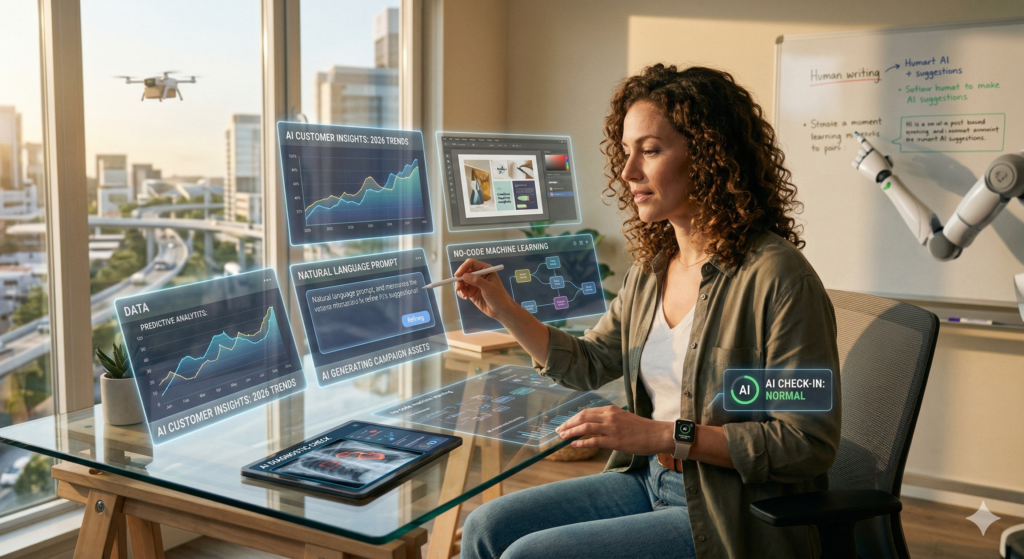
Let’s start by busting a huge myth. Most people think AI (Artificial Intelligence) is a shiny, sentient robot that’s about to wake up and decide it doesn’t need humans anymore. Honestly? It’s not that dramatic. It isn’t a “ghost in the machine” or a magic box that magically knows everything. At its core, it is just incredibly smart math designed to solve specific problems. It doesn’t “feel” or “want”—it just processes.
1. The “Not-So-Scary” Intro to AI
A lot of people are walking around right now thinking that AI (Artificial Intelligence) is some kind of sentient, digital ghost that has “woken up” inside our computers. Honestly? That’s just sci-fi rubbish. Despite what the movies tell you, AI doesn’t have a soul, it doesn’t have a “will,” and it certainly isn’t planning world domination while you sleep. It’s a tool—a incredibly sophisticated one, sure—but it’s built on math, not magic. It’s essentially the world’s most advanced pattern-recognition machine.
From Sci-Fi Dream to Smartphone Reality
Just a decade ago, if you talked about AI technology, people thought of Terminator or Star Trek. Fast forward to 2026, and it’s the invisible force that helps you avoid traffic on your morning commute and suggests the perfect reply to your boss’s email. We have transitioned from “experimental” tech into “ambient” tech. This means it’s everywhere, but we hardly notice it anymore. Whether you are using ChatGPT, Gemini, or specialized artificial intelligence solutions at work, you are interacting with a system that has been trained on trillions of data points to make your life just a little bit smoother.
Why the 2026 Shift Matters
In previous years, we spent a lot of time just “playing” with chatbots. In 2026, the shift is toward agentic AI. This is where the tech stops just answering questions and starts actually doing things for you. It’s the difference between a tool that tells you how to book a flight and an AI-powered tool that actually goes out, finds the best price, and books it while you’re at lunch. The mystery is fading, and the utility is taking center stage. So, are you ready to stop being intimidated and start using it as your digital sidekick?
2. How Does Artificial Intelligence Work for Beginners?
There is a common belief that you need to be a math genius or a senior software engineer to understand how does artificial intelligence work for beginners. People think there’s some secret code that only “tech bros” can read. Let’s kill that myth right now. You don’t need to know how a combustion engine works to drive a car, and you don’t need to understand the calculus behind neural networks to use AI. At its heart, it’s just a system that learns by example rather than by following a rigid list of rules.
The Engine Under the Hood: Machine Learning
If traditional software is a recipe (if this happens, then do that), machine learning is like teaching a child what a “dog” is by showing them a thousand pictures of dogs. Eventually, the child—or the computer—recognizes the patterns (the ears, the tail, the fur) and can identify a dog they’ve never seen before. This is the foundation of machine intelligence. It’s about feeding big data into algorithms so the computer can make its own “guesses” based on what it has seen in the past.
Deep Learning and the Human-Inspired Brain
To take it a step further, we have deep learning. This uses neural networks, which are mathematical layers designed to mimic the way human neurons fire. This is how we get Natural Language Processing (NLP)—the tech that allows your computer to understand your sarcastic tone or your messy handwriting. These intelligent systems don’t “understand” the meaning of life, but they are masters at predicting which word should come next in a sentence. It’s math disguised as conversation.
Large Language Models (LLMs) and Data Science
When you interact with OpenAI or other generative AI platforms, you’re talking to a Large Language Model (LLM). These are the giants of the data science world. They’ve read almost everything on the public internet, which allows them to simulate human-like reasoning. They don’t have “knowledge” in the traditional sense; they have a massive map of how words and concepts relate to each other. It’s a specialized form of automation that makes it feel like you have a research assistant who has read every book ever written.
3. Narrow AI vs. AGI: Are the Robots Actually Coming?
The biggest fear-mongering headline in tech today is that AI (Artificial Intelligence) is about to become “sentient” and surpass human intelligence in every way. People often use the term Artificial General Intelligence (AGI) as if it’s already here, waiting in a server farm to take over. But here is the truth: AGI—the kind of intelligence that can reason, feel, and adapt like a human across any subject—is still largely a theoretical concept. We are still living in the age of “specialists,” not “gods.”
Narrow AI: The High-Performing Specialist
Narrow AI is the AI technology we use every day. Its primary feature is its absolute mastery of a single, specific task. Think of the algorithms that power your social media feed or the robotics that assemble cars in a factory. These are intelligent systems that are “narrow” because they can’t do anything else. A chess-playing AI is a grandmaster at the board, but it wouldn’t know how to boil an egg or tell a joke.
- Pros: It is incredibly fast, highly accurate within its niche, and can handle repetitive automation tasks that would drive a human to boredom. It’s the ultimate efficiency booster for modern business.
- Cons: It’s “brittle.” If the data changes slightly or the task shifts outside its training, it fails. It has zero common sense and can’t improvise.
- Final Verdict: Narrow AI is the most reliable and profitable form of artificial intelligence solutions available in 2026. It’s a tool you should be using right now to scale your output.
Artificial General Intelligence (AGI): The Digital Horizon
The feature that defines AGI is “transferable intelligence.” This would be a form of machine intelligence that can learn a new skill (like surgery) and then use that logic to solve a different problem (like climate change). It’s the dream of data science: a machine that can truly “think” and adapt. While LLMs like GPT-5 or Gemini 2.5 Ultra are showing glimpses of cross-domain reasoning, they still operate based on probability, not true consciousness.
- Pros: The potential to solve humanity’s “unsolvable” problems, from curing cancer to managing global resources with zero waste. It represents the peak of human achievement in AI (Artificial Intelligence).
- Cons: The “alignment problem.” If a machine is smarter than us, how do we make sure its goals don’t accidentally harm us? There are also massive ethical and privacy risks that we aren’t fully prepared for.
- Final Verdict: AGI is a fascinating subject for 2026 research, but don’t lose sleep over it. It’s not in your living room yet, and we are still years—perhaps decades—away from a system that truly “thinks” for itself.
4. Small Business Superpowers: AI-Powered Tools You Need
There’s a myth that AI (Artificial Intelligence) is only for the “big boys”—the Googles and Apples of the world. Small business owners often think they don’t have the budget or the “nerd power” to use it. That is total rubbish. In 2026, the most powerful artificial intelligence solutions are actually designed for the “little guy.” They are affordable, user-friendly, and designed to make a one-person shop look like a Fortune 500 company.
Productivity Agents: Your New Virtual Staff
The standout feature of modern AI-powered tools for business is “agency.” We’re talking about tools that don’t just draft an email but manage your entire calendar, follow up with leads, and summarize your meetings automatically. These tools use NLP and predictive analytics to anticipate what you need before you even ask for it.
- Pros: It slashes your overhead. You can handle the workload of three people without hiring anyone. It eliminates the “busy work” of data entry and scheduling, letting you focus on the creative strategy that actually makes you money.
- Cons: It requires a bit of an “onboarding” period to trust the machine. If you don’t set the guardrails correctly, the AI might send a weirdly worded email to a client or miss a nuance in a contract.
- Final Verdict: Investing in best AI tools for small business productivity in 2026 is the single smartest move you can make. It’s not about replacing you; it’s about giving you 10x more time to be you.
Generative Art: The Best Free AI Image Generators
For content creators, the feature that changed everything is text-to-image generation. Using computer vision and generative AI, tools like Nano Banana 2 or Flux 2 Pro allow you to create stunning, custom visuals just by typing a sentence. No more paying $50 for a stale stock photo that everyone else is using.
- Pros: Instant, high-quality visuals for your blog, social media, or ads. It levels the playing field for people who aren’t naturally artistic but have great ideas. It’s a huge win for branding and engagement.
- Cons: The “uncanny valley” effect—sometimes hands have six fingers or eyes look a bit “off.” There are also ongoing legal debates about copyright and “AI-free” labels that you have to navigate carefully.
- Final Verdict: These are essential AI-powered tools for any modern creator. They won’t replace a top-tier designer for a logo, but for daily content, they are a game-changer for your budget and speed.
5. AI in the Real World: Healthcare and Customer Service
You might have heard that AI (Artificial Intelligence) is going to replace your doctor or that you’ll never speak to a human again when calling customer support. This is a massive oversimplification. AI isn’t here to fire the doctor; it’s here to give the doctor x-ray vision and a photographic memory. It’s not about cutting humans out of the loop; it’s about making sure the humans in the loop have the best possible information to work with.
Healthcare: The Diagnostic Revolution
The core feature of AI technology in 2026 healthcare is EHR (Electronic Health Record) integration. AI systems now sit “on top” of patient records, using deep learning to scan for patterns in your history, labs, and even your wearable device data. It can flag a potential heart issue or a pediatric developmental risk months before a human might notice a symptom. It’s also a powerhouse in medical image analysis, spotting tumors with a level of precision that is frankly superhuman.
- Pros: Faster, more accurate diagnoses and a massive reduction in “physician burnout.” It handles the 70% of a doctor’s day that is usually spent on paperwork, returning that time to actual patient care. It saves lives by catching things early.
- Cons: Privacy is a huge hurdle. There’s also the “Black Box” problem—if an AI flags a risk, a doctor needs to know why so they can explain it to the patient. We also have to watch out for algorithmic bias in medical data.
- Final Verdict: This is the future of medicine. We are moving toward “personalized healthcare” where artificial intelligence solutions tailor your treatment to your specific DNA and lifestyle. It’s a literal life-saver.
Customer Service: The Rise of Autonomous Agents
In 2026, customer service has moved past the “press 1 for sales” nightmare. The primary feature of modern AI technology here is the autonomous agent. These aren’t just bots; they are intelligent systems that can access your account, process a refund, and update your records in real-time without ever needing a human manager to “approve” the request. They use sentiment analysis to tell if you’re angry and adjust their tone accordingly.
- Pros: 24/7 support with zero wait times. It provides a consistent, polite experience every single time. For businesses, it allows for infinite scaling without the massive cost of a call center.
- Cons: It lacks true human empathy. If a situation is deeply complex or emotional, an AI can feel cold or frustrating. There’s a risk of “looping” where the bot doesn’t understand a unique problem.
- Final Verdict: For routine tasks—tracking orders, password resets, basic questions—AI is the clear winner. It’s an essential part of how AI improves customer service, as long as there is always a “human” button for the really tough stuff.
6. The Future of Your Paycheck: Impact of AI on the Future of Work
The scariest myth out there is that AI (Artificial Intelligence) is a “job delete” button. We’ve all seen the headlines about millions of jobs disappearing. But history shows us a different pattern: the Industrial Revolution didn’t end work, it just changed what “work” looked like. In 2026, we aren’t seeing a mass exit from the workforce; we’re seeing a massive upgrade in the skills required to stay in it.
The Rise of the Human-AI Hybrid Team
The defining feature of the 2026 workforce is the “hybrid” model. Most companies no longer hire just for a specific skill; they hire for the ability to collaborate with machine intelligence. This has created entirely new roles, like prompt engineering (the art of talking to AI) and AI Ethics Officers. We are seeing a shift where entry-level roles are being “automated up,” turning former data entry clerks into high-level data analysts.
- Pros: Massive productivity gains and a higher standard of living. Workers with AI technology skills are seeing 50%+ wage premiums compared to those without them. It removes the “soul-crushing” manual labor from most office jobs.
- Cons: There is a real “skills earthquake” happening. If you don’t adapt, you risk being left behind. Middle management roles are shrinking as AI handles more scheduling and reporting, forcing leaders to become more strategic and “human-focused.”
- Final Verdict: The impact of AI on the future of work is actually an opportunity for those willing to learn. The most valuable professionals in 2026 are those who combine technical AI fluency with very human traits like empathy, resilience, and creative leadership.
Industry-Specific Transformations
From accounting to warehouse work, automation is changing the landscape. In finance, AI handles the bookkeeping with perfect accuracy, while in sales, it creates hyper-personalized content for every lead. The feature here is “hyper-specialization.” You no longer have to be a “jack of all trades”—you can be the master of the strategy while the AI handles the execution.
- Pros: Businesses are more efficient, and products are getting cheaper and better. It allows humans to focus on innovation and “high-value” tasks that require a moral or creative judgment.
- Cons: Displacement is real in specific sectors like retail and data entry. The transition is painful for those who have spent decades doing manual tasks that are now easily handled by intelligent systems.
- Final Verdict: This isn’t a threat you can ignore; it’s a wave you have to learn to surf. The “workforce of the future” is already here, and it’s powered by a mix of human intelligence and artificial intelligence solutions.
7. Can You Join the Party? Learn Machine Learning Without Coding
Finally, let’s address the belief that you need a PhD to even understand machine learning. People often think that if they aren’t good at math or coding, they have no place in the world of AI (Artificial Intelligence). That is a total lie. The “no-code” revolution has arrived, and it has opened the doors for everyone. You don’t need to be a developer to build an intelligent system anymore; you just need to be a problem solver.
The No-Code Revolution: Drag-and-Drop AI
The primary feature of how to learn machine learning with no coding experience is the visual platform. Tools from giants like Google and IBM allow you to build and train models using simple drag-and-drop interfaces. You provide the data, pick the “goal,” and the platform handles the underlying algorithms and neural networks for you. It’s like using a website builder instead of writing HTML from scratch.
- Pros: It is incredibly accessible and fast. You can go from an idea to a working “prototype” in a single afternoon. It demystifies the tech and lets you see the “magic” for yourself without the headache of debugging code.
- Cons: You are limited by the features of the platform you choose. You won’t have the same “under-the-hood” control as a data scientist writing custom Python scripts. There’s also a danger of “garbage in, garbage out” if you don’t understand basic data quality.
- Final Verdict: This is the best way for 99% of people to start. It turns AI technology from a scary black box into a tool you can actually use to improve your business or your hobby.
Interactive Learning: Courses for Humans, Not Robots
If you want to go a bit deeper, the standout feature of 2026 education is “interactive learning.” Platforms like Coursera and DataCamp have moved away from dry lectures and into hands-on simulations. You learn data science and NLP by actually building small projects—like a spam filter or a simple chatbot—in a safe, guided environment. They focus on the “logic” of AI, which is much more important than memorizing formulas.
Final Verdict: Knowledge is the new currency. Even a basic understanding of how machine intelligence works will put you ahead of 90% of the population. Pick one course, stick to it, and stop being a spectator.
Pros: Most of these resources are low-cost or free. They allow you to build a portfolio of “AI projects” that prove your skills to employers. You can learn at your own pace and focus only on the parts of AI (Artificial Intelligence) that actually interest you.
Cons: It takes discipline. With so many courses available, it’s easy to get “tutorial paralysis” and never actually finish anything. Some courses still use too much jargon that can be discouraging for total beginners.