
Have you ever wondered what comes after the laptop or smartphone you are using right now?
Welcome to the wild and exciting world of quantum computing. For decades, it sounded like pure science fiction—a futuristic super-machine capable of solving complex problems that would take regular computers thousands of years to crack. But the most thrilling part is that we are finally moving past the crazy theories and starting to see this mind-bending tech solve real-world problems. Let’s break down exactly how we got here and where this incredible technology is heading next!
The Origins of Quantum Computing: Bits vs. Qubits
People first started thinking in the 1980s that you could build a computer that uses the quantum properties of matter to perform calculations much more quickly than traditional computers.
All computers today work with “bits”, which are either on or off. But a quantum equivalent of a bit—a “qubit”—could be simultaneously on and off, because of the peculiar way matter behaves at the quantum level.
Physicists like Richard Feynman and David Deutsch theorized that if you could replace a computer’s bits with qubits, this behavior could be harnessed to make computation orders of magnitude quicker.
However, getting from theory to practice proved depressingly difficult. It took years of research to get from creating one qubit up to a system using three qubits, whereas modern computers have billions of bits. Because of this hurdle, people started to move away from the ambition of using qubits to build a “universal computer.” Instead, the focus shifted to whether there were other ways to use quantum effects to perform a more limited range of specific types of computation.
The Calculator Analogy:
It’s like the difference between calculators and computers. If you’re old enough to remember pocket calculators, they couldn’t do everything your smartphone can do now. But they could do a limited number of things very well—far better than the alternative of working it out with a pencil and paper. That’s where we are now. “Quantum calculator” would probably be a better description than “quantum computer” for the processors currently in use. Their domains are relatively narrow, but within those domains, they enable exciting applications.
Solving the Unsolvable: The Power of Quantum Annealing
Quantum processing is highly susceptible to problems that involve looking for the best solutions among a vast array of possible options.
Generally, there are two ways to approach this kind of complex problem:
Exhaustive Search:
Consider all the options in turn, and see which one is best. But pretty quickly, that becomes impractical. If you imagine just 250 questions that can be answered with either yes or no, you already have more possible combinations than there are atoms in the observable universe.
Heuristics:
Use tricks and techniques that have evolved over hundreds of years for situations when you’re not realistically hoping to find the best possible answer, but an acceptably good answer in a short time frame.
The quantum behavior of matter allows these processors to quickly arrive at optimal answers through a process known as quantum annealing. The aim is to get answers that are closer to what you’d get from an exhaustive search, but in the same timescale it takes to run standard heuristics.
Real-World Applications: From Drug Discovery to Finance
Today, tech companies are actively building real-world software to harness this immense computational power. For example, a recently patented tool can compare multidimensional structures and decide which are most similar to each other.
Drug Development:
If you have a completely new molecule and want to predict what effect it will have on the body, one way to do so is to compare it to a database of molecules with known effects. Does it look more like a molecule that cures cancer, or one that causes heart disease?
Computational Finance:
You could just as well apply this software to anything that can be conceived of as a collection of nodes and edges—what in mathematics are known as graphs. In finance, you could represent various possible portfolios as graphs and compare them to find the optimal combination of financial instruments in a limited time frame.
Graph comparison is just one of many exciting software tools developers are building for today’s quantum processors. As these processors get larger and larger chips, the applications built on these kernels of software will become significantly more powerful.
The Hardware and the Collaborative Ecosystem
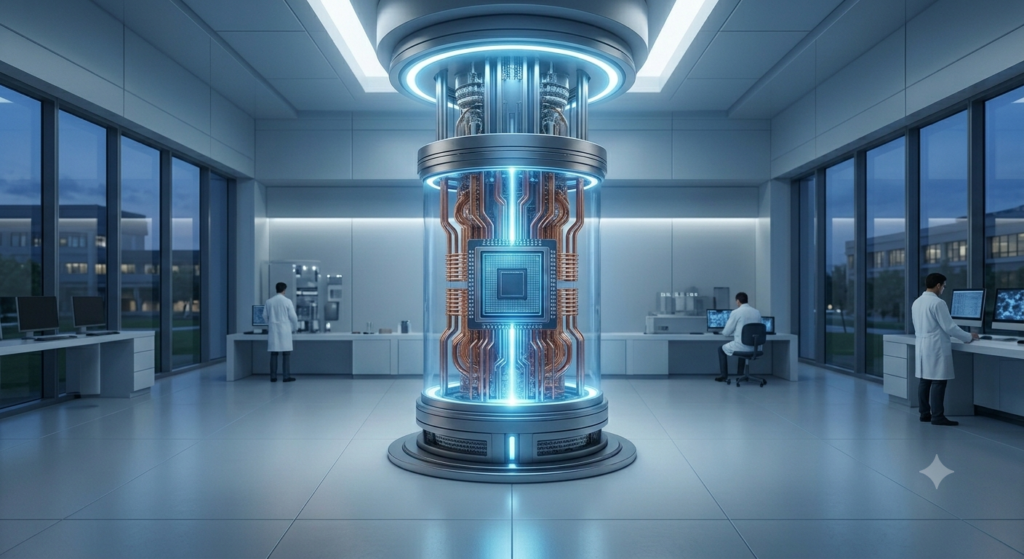
Our software currently runs on a system produced by our partner, D-Wave. To unlock true quantum behavior, engineers must keep these processors in a vacuum, shield them from the Earth’s magnetic field, and freeze them to near absolute zero. In terms of the scale of equipment required to do this, you can compare it to the first mainframe computers from the 1960s rather than the personal computers of today.
While D-Wave is currently the only commercial entity producing a quantum processor you can actively buy, there is incredible work being done across the industry by start-ups, academia, and tech giants like Google, Microsoft, and IBM. Some of this work focuses on super-conducting systems like the D-Wave, while others explore more exotic and experimental avenues.
Researchers constantly publish new findings, while formal and informal working groups keep the entire industry connected. For instance, the D-Wave users group includes organizations like NASA, Lockheed Martin, Google, and the Universities Space Research Association. Because the field is emerging, there isn’t much cutthroat competitiveness; everyone knows that generating momentum for the field as a whole benefits everyone.
The Future: A 20-Year Horizon of Quantum Computing
Predicting where the industry will be is easiest when looking at the immediate short-term and the distant long-term:
The Short-Term (1 Year):
There’s been a fairly consistent trend of the number of qubits doubling each year. With D-Wave recently announcing the release of the first processor with more than 1,000 qubits, it is expected that we will see processors with over 2,000 qubits within a year.
The Long-Term (20 Years):
Almost everyone agrees that within two decades, we will have finally developed the more general-purpose, universal quantum computers originally envisaged by Richard Feynman back in the 1980s.
What remains uncertain is the intermediate time frame, as there are a million different paths we could take to get there. The ultimate hope is that broadening access to the technology will drive progress. By building software for other developers to build upon, people will eventually be able to play around with quantum computing the same way they now play around with Android phones—and when that happens, a tidal wave of exciting new applications will follow.